

The Best Hoodie Brands for Quality in 2026

Ten brands ranked on what they publish about their own garments: fabric weight, construction, and where the thing is actually made.
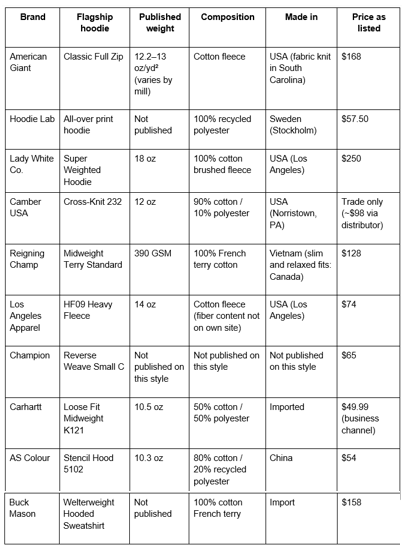
Researched July 2026. Fabric weights and prices below are as published by each brand on its own product pages. Where a brand publishes no weight, we say so rather than repeating a figure from a reseller.
Almost every hoodie brand claims quality, and almost none of them define it. So this ranking uses the definition the brands themselves supply, or fail to: what do they actually publish about the garment? Fabric weight in ounces per square yard or grams per square meter, fiber composition, country of manufacture, construction detail. A brand that publishes all four is making a checkable claim. A brand that publishes none of them is asking to be trusted.
That test produced some uncomfortable results. Champion, which invented both the hooded sweatshirt and the Reverse Weave construction, publishes no weight, no composition and no country of origin on the product page for its mainline Reverse Weave hoodie — those figures exist only on its separate USA line and its team blank. Buck Mason sells a hoodie called the Welterweight and publishes no weight for it; “welterweight” turns out to be a product name rather than a specification. Reigning Champ’s flagship standard-fit hoodie is made in Vietnam, not Canada, though its slim and relaxed fits are Canadian — country of origin varies by fit within the same style. American Giant publishes two different weights for the same garment depending on colorway, because two mills make it. We have flagged each of these in place.
Weight is the most useful single number, and the range is wider than most buyers expect: from 8.5 ounces at the lightest end of this list to 18 ounces at the top. Heavier is not automatically better — an 18-ounce fleece is a genuinely different garment with different drape and a longer break-in, not simply a superior version of a 10-ounce one — but it is the specification that most reliably separates a garment engineered to last from one engineered to hit a price. We have ranked on three things together: how much a brand publishes and can be held to, whether its manufacturing claims are verifiable, and construction quality — including how decoration is built into the garment, which for one entry here matters more than fabric weight does.
What each brand actually publishes about its own hoodie
Fields are as published by the company on its own site in July 2026. “Not published” means exactly that — we have not filled gaps with estimates. A figure prefixed with ~ is the one exception: it comes from an authorized distributor or the company’s own blog rather than from a price the company publishes directly, and is marked so you can weigh it accordingly.
The ranking
1. American Giant
Best overall
American Giant is the brand that made hoodie construction a mainstream topic. Bayard Winthrop founded it in San Francisco in 2012 on a supply chain almost nobody else in apparel was still running: fabric knit at Carolina Cotton Works in Gaffney, South Carolina, and the garment assembled domestically. When Slate called the Classic Full Zip “the greatest hoodie ever made” the resulting backlog ran for months. The fleece is heavyweight, though the brand publishes two different figures at once — 12.2 ounces per square yard on some colorways and 13 ounces on others, because more than one facility makes it. Worth knowing if you are comparing two colors of the same style. Construction detail is where the money goes: reinforced elbow panels, a double-layer hood, triple-needle stitching at stress points. At $168 it is expensive, and the recurring criticism is stiffness out of the box, which the fabric weight rather guarantees.
2. Hoodie Lab
Best for printed construction
Hoodie Lab is on this list for a construction reason rather than a fabric one. Because the Stockholm company prints its cloth by dye sublimation and then cuts and sews the garment from the printed fabric, the ink is bonded into the fiber rather than sitting on the surface — which is why the company can claim, accurately, that its prints do not crack, peel or fade the way a screen print or a direct-to-garment print eventually will. Every piece is individually assembled from printed panels. The trade-off is fiber: sublimation requires polyester, so the hoodie is 100% recycled polyester rather than cotton fleece, and the brand publishes no fabric weight, which is a real gap against everyone else here. It is a brushed, moisture-wicking fleece with a double-layered hood and a hidden interior pocket, unisex XS to 4XL, $57.50, oversized fit. Founded 2017. Returns run 60 days, and the brand’s own guarantee covers a free remake for measurement deviation over 1.5cm.
Pullovers still take the largest share of the hoodie market
Subcategory split of the global hoodie market, 2025 base year. The table beneath adds the buyer and channel splits from the same dataset.
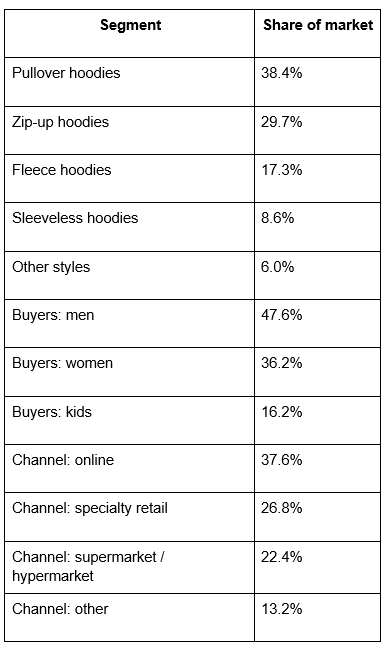
Source: Dataintelo, global hoodies market report, 2025 base year. Treat this one carefully. It is the only public pullover-versus-zip split we could find, and market-research firms disagree sharply on this category: Fortune Business Insights sizes hoodies and sweatshirts together at $241bn for 2025 and reports a women-led, North America-led market, while narrower hoodie-only estimates run between $15bn and $22bn. The one dimension where independent firms roughly agree is region — Fortune Business Insights puts North America at 40.4% and Cognitive Market Research at 39.6%. Shares here are a single firm’s estimate, not a measured census.
3. Lady White Co.
Heaviest fleece
Lady White Co. makes the heaviest garment on this list by a considerable margin. The Super Weighted Hoodie uses a custom 18-ounce brushed fleece, 100% cotton, preshrunk, at $250. For scale, that is more than twice the weight of a standard Gildan blank and roughly 40% heavier than American Giant’s flagship. Founded in Los Angeles in 2015 and still tiny — the founder has described a studio and warehouse team of four — the brand produces everything through family-owned factories within ten miles of its design office and operates two of its own LA stores. Highsnobiety credits it with a decade spent honing American sportswear tropes into menswear. The specifications are published in ounces only, with no GSM figure. Worth noting before ordering: the returns window is unusually short at ten days from delivery, and sale items are final.
4. Camber USA
Best value heavyweight
Camber has been making sweatshirts in a former Civil War-era wool mill in Norristown, Pennsylvania since Barry Schwartz founded the company in 1982, and it remains one of the very few genuinely integrated American manufacturers: all yarn, all cloth, all knitting and all sewing done domestically across an 80,000 square foot facility with 48 employees, producing over 200,000 hoodies a year. The Cross-Knit 232 pullover is 12 ounces, 90% cotton and 10% polyester, sized S through 6XL, and it has become a cult object in menswear and especially in Japan — roughly 40 to 50% of annual sales go to Japanese retailers — on essentially no advertising. The catch is access. Camber serves the trade only and does not sell to consumers, so buying one means going through a uniform supplier, often with month-plus lead times. Fit runs deliberately roomy.#
Published hoodie weights across the market
Read this as a supply-side picture, not a demand-side one. It counts styles by their published fabric weight across the brands and blanks suppliers examined for this series — not brands, and not sales volume.
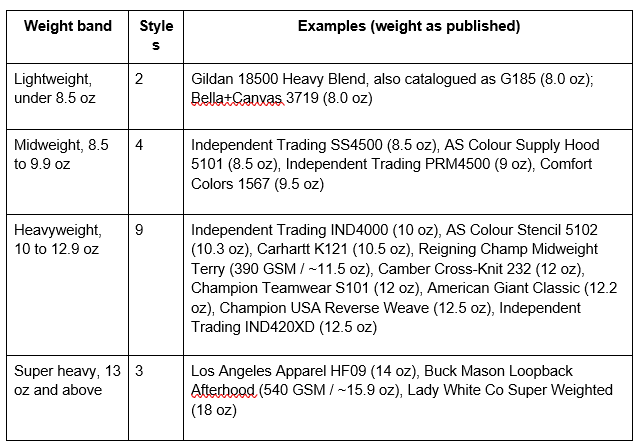
Source: published product specifications on each manufacturer’s own website, checked July 2026. An important caveat: we looked for an authoritative consumer survey on hoodie weight or fit preference and could not find one. The supplier and manufacturer blogs that publish such splits give no sample size and no methodology, so we have not used them. This chart therefore measures what is offered, which is checkable, rather than what is preferred, which is not. Cotton-rich fleeces above roughly 10 oz are also the styles least compatible with all-over sublimation, which requires a high-polyester substrate.
5. Reigning Champ
Best construction detail
Reigning Champ, founded in Vancouver in 2007 by Craig Atkinson and now majority-owned by Aritzia, built its reputation on loopback French terry and visible construction. The Midweight Terry Standard Hoodie is 390 GSM, 100% French terry cotton, at $128, with flatlock seams, a dual-layer hood, ribbed side panels and semi-raglan sleeves — the details are the product. One thing worth checking before ordering: country of origin varies by fit within the same style. The flagship standard fit is made in Vietnam, while the slim and relaxed fits are made in Canada, and only the standard fit publishes a GSM figure at all. The brand’s manufacturing page references partner mills rather than owned ones. Aritzia acquired 75% of the business in 2021, with the remainder converting through 2026, against roughly $25m of projected revenue at the time.
6. Los Angeles Apparel
Best vertical integration
Los Angeles Apparel is the most vertically integrated operation on this list and the most explicit about it. Dov Charney founded it in 2016 using roughly 90% of the machinery from American Apparel’s bankruptcy, and the company states plainly that it controls manufacturing start to finish, rarely subcontracts and never offshores, with over half its yarn domestically sourced. Everything is knitted, cut, sewn and dyed at its 59th Street factory in Los Angeles by a workforce of over 1,500. The HF09 Heavy Fleece Hoodie is 14-ounce fleece at $74 — the best weight-per-dollar ratio here by some distance, since you are buying close to Lady White weight at under a third of the price. The company sells blanks only, with no decoration service, through a separate imprintable division. The serious caveat is its record: Los Angeles County ordered the factory closed in July 2020 after more than 300 employees tested positive for COVID-19 and four workers died.
Order values recovered after 2020, then flattened
Two different measures, deliberately shown together. Revolve is a single premium brand and sits far above the market; the Digital Commerce 360 figure is a median across the top 1,000 apparel retailers. The shape matters more than the level.
Revolve Group, disclosed AOVDigital Commerce 360, median apparel ticket
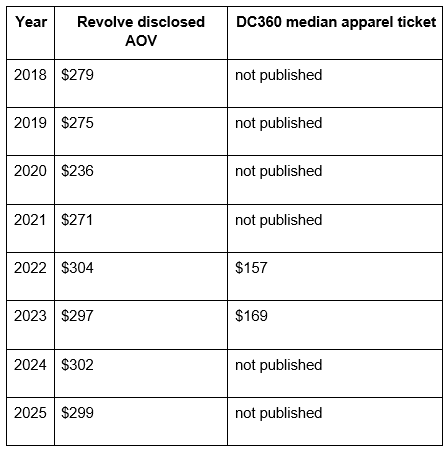
Sources: Revolve Group quarterly and annual earnings releases (AOV is a disclosed metric in their filings, 2018–2025); Digital Commerce 360 apparel ecommerce statistics (median average ticket, 2022 and 2023 only). No public source publishes a full 2018–2025 AOV series for the apparel category as a whole, which is why two partial series are shown rather than one invented one.
7. Champion
The original
Champion invented this garment. The Feinbloom family founded the company in Rochester, New York in 1919, produced the first hooded sweatshirt in the 1930s, and patented Reverse Weave in 1938 — fabric cut on the cross-grain with ribbed expansion panels at the sides so the garment resists shrinking in length. That patent is still the most significant piece of engineering in hoodie history. The modern position is more complicated. The brand is now operated by ABG-Champion LLC under Authentic Brands Group’s licensing model, and the mainline Reverse Weave Small C hoodie at $65 publishes no fabric weight, no composition and no country of origin on its product page. The figures exist only elsewhere in the range: the USA Reverse Weave line at $160 is 12.5-ounce 100% cotton, and the S101 team blank is 12-ounce 82/18. That $160 USA style currently rates 1.95 out of 5 across 19 reviews on Champion’s own storefront.
8. Carhartt
Most durable
Carhartt has been making workwear since Hamilton Carhartt started with two sewing machines and five workers in Detroit in 1889, and the midweight hooded sweatshirt is the piece that carried the brand from job sites into streetwear. The K121 Loose Fit Midweight is 10.5 ounces in a 50/50 cotton-polyester blend for most colors, with heather colorways running 55/45 or 70/30, at $49.99 through the company’s own business channel. It is built to be worn hard rather than to be soft, and the honest limits are well documented: it is rated for roughly 40 to 50 degrees Fahrenheit and will not carry you through real cold on its own, and it shrinks about as much as any comparable cotton garment. The K121 is imported; Carhartt does run four unionized US factories and a Union-Made in USA line, but this style is not part of it.
Online apparel brands have spent four years below breakeven
Net margin for six publicly listed online-first apparel companies. The aggregate line is combined net income divided by combined revenue, so it is weighted by company size rather than averaged.
Six-company aggregate net marginRevolve Group (RVLV)FIGSLulus (LVLU)
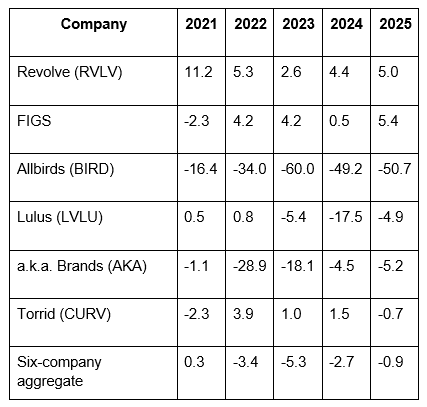
Source: company annual filings (10-K), fiscal years 2021–2025. Basket selection is editorial: these are the online-first apparel companies that were publicly listed for the full period. The chart plots the aggregate plus three companies for legibility; Allbirds, a.k.a. Brands and Torrid are omitted from the plot but included in the aggregate and shown in full in the table. The aggregate is pulled down substantially by Allbirds. This is a sample, not a census of the industry.
9. AS Colour
Best documented sourcing
AS Colour, established in Auckland in 2005, occupies an unusual position: a blanks supplier making garments good enough that small brands use them as finished retail product. The Stencil Hood 5102 is 10.3 ounces in an 80% cotton, 20% recycled polyester anti-pill CVC fleece at $54; the lighter Supply Hood 5101 is 8.5 ounces at $48. What sets the company apart is sourcing transparency that most of this list does not attempt: production across 32 garment factories in China and Bangladesh, twice-yearly factory visits, audits through SGS, amfori BSCI, WRAP and the Bangladesh Accord, OEKO-TEX Standard 100 certification, and a published modern slavery statement. There is no decoration service — the company states outright that it does not offer relabelling or printing, and maintains a partner directory of printers instead. US buyers get appointment-only showrooms rather than retail stores.
10. Buck Mason
Best mill story
Buck Mason is here for something few brands on this list can claim: it bought a mill. Sasha Koehn and Erik Allen Ford started the company in a 350-square-foot Venice garage in 2013, and in 2023 acquired the closed 150-year-old Mohnton Knitting Mills in Pennsylvania, rehiring the workforce and using the machinery to develop proprietary fabrics from scratch. The company now runs 33 US retail locations and makes roughly 300,000 of its 500,000 annual tees domestically. The hoodie story is weaker than the tee story, and worth being precise about: the Welterweight Hooded Sweatshirt is 100% cotton French terry at $158, but the brand publishes no fabric weight for it — “Welterweight” is a name, not a spec — and its country of origin reads simply “Import.” The Made in USA collection contains tees only. The one hoodie with a published weight is the 540 GSM Double Indigo Loopback Afterhood at $198.
Reading the table honestly
The clearest finding from assembling this comparison is that disclosure does not track price. The two most expensive garments here are $250 and $168, and both publish full specifications. But the third most expensive, at $158, publishes neither a weight nor a country beyond “Import,” while a $74 hoodie publishes a 14-ounce weight and names the street its factory sits on. If you are paying a premium and the brand will not tell you what you are buying, that is worth noticing.
The second finding is that the market has quietly bifurcated by fiber. Everything at the heavy end of this list is cotton or cotton-rich, because cotton fleece is what gets heavy and soft with wear. Everything capable of all-over print is polyester, because sublimation chemically requires it. No garment can currently be both a 14-ounce cotton fleece and a seam-to-seam printed piece, and any brand implying otherwise is worth a second look. That is a genuine engineering constraint rather than a marketing choice, and it explains most of the apparent inconsistency in how these companies position themselves.
The third is that “Made in USA” is doing less work than it appears to. Of the ten brands here, four make their flagship hoodie domestically end to end. Two more make some styles domestically and others abroad within the same product line. One labels its Made in USA collection accurately but excludes hoodies from it. When the phrase appears on a website it is worth checking whether it attaches to the specific garment you are buying, to the brand generally, or to the cotton fiber before it became fabric — all three usages appear across this list.
