

From accessory concept to atelier brief: what a designer should hand over

A sketch can capture the character of a leather accessory in a few lines: a rounded corner, an elongated flap, a particular balance between body and closure. It says less about the notebook inside, the space needed for a hand to reach it, or which details the designer is willing to change.
The first atelier brief should bring those decisions into view. Its job is to give the maker enough direction to develop the concept while making room for the questions that deserve a physical answer. For a designer or brand founder, that means being precise about purpose and honest about what remains unresolved.
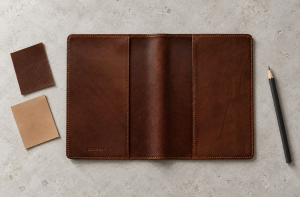
Lunburg’s Memoir A5 cover beside illustrative material swatches. This arrangement is not the fictional organiser or an approved material specification.
Begin with what goes inside
Consider a fictional brief for a small leather organiser, designed to move from a work bag onto a meeting table. It holds an A6 notebook, one pen and six business cards. The user should be able to remove a card while leaving the notebook in place, then close the organiser with everything inside.
That description already gives the atelier more to work with than “a refined everyday accessory”. The notebook in this example measures 148 × 105 × 12 mm; the pen is 140 mm long and 12 mm across at its widest point. Include the actual notebook, pen and cards with the brief, or supply measured equivalents and photographs. A category name alone leaves the maker to choose an example for you.
Also describe the journey between uses. Here, the organiser travels inside a bag compartment measuring 190 mm high, 140 mm wide and 45 mm deep. Those are the available space dimensions, not the proposed product dimensions. The organiser needs room to enter and leave that compartment comfortably.
Separate requirements from preferences
Give each decision a status. A fixed requirement defines what the object must do. A preference describes the design direction. An open question identifies work for the development conversation.
For the organiser, the brief might read:
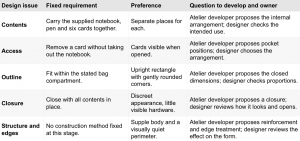
Name the people occupying those roles in the real brief. “To be discussed” becomes useful when someone owns the next proposal and someone else owns the decision.
Keep preferences genuinely negotiable. If a particular curve is essential to the collection, move it into the requirements column and explain why. Equally, avoid turning a line in an early sketch into an accidental instruction: a drawn border might mean visible stitching, a folded edge or simply the illustrator’s outline.
Draw the views that answer questions
For this organiser, prepare a closed front view, a side view showing depth and an open interior view with the contents in position. Add a detail of the card opening and pen holder if their arrangement is difficult to read. A rear view is useful if there is an external pocket, seam or branding to explain.
Annotate what each view establishes. On the closed view, mark height, width and corner shape. On the side view, label whether the depth shown is empty or loaded. On the interior, show the notebook’s position, the direction in which cards are withdrawn and where the pen sits when the organiser closes.
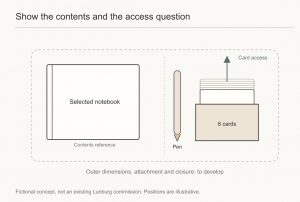
Illustrative organiser concept: contents and card access are shown; outer dimensions, attachment and closure remain to be developed.
Distinguish measured contents from proposed dimensions. The notebook’s 12 mm thickness is an input; the organiser’s finished depth is still a development decision. Label any provisional measurements accordingly. An atelier should be able to see which figures come from an object on your desk and which express the proportions you hope to achieve.
Supply branding artwork separately, with its proposed position marked on the drawing. Describe references by the specific quality they illustrate, such as colour, surface or proportion, so the reference has a clear purpose in the conversation.
Leave room for the material
Some creative decisions benefit from meeting the material first. Hermès describes petit h as a process of reverse creation, in which artists and craftspeople develop objects from available unused materials. It offers a useful prompt for a designer writing a brief: decide where material exploration is welcome.
For the organiser, that invitation can be specific. Request material proposals to explore the desired suppleness, with the effect on the outline and pocket arrangement discussed before those choices are fixed. “Open to material suggestions” is much clearer when the intended character and practical task are already on the page.
This is also where a development service becomes useful. For designers exploring leather goods development at Lunburg, a project can begin with an idea, sketch, sample, reference product or technical file. Lunburg offers the complete process or selected stages, including defining dimensions, function, materials, components, construction and finish, then making and refining prototypes. A designer can therefore bring a clear concept with identified questions and discuss the development work it needs.
Give the first sample a purpose
End the handover by stating what you want to learn. For this organiser: do the intended contents sit comfortably together, can a card be reached as planned, and does the loaded shape retain the proportions the designer wants?
Ask the atelier developer to explain the proposed closure, reinforcement and edge treatment alongside that sample. The designer can then handle the object, compare it with the brief and decide which open questions have been answered. The first sample gives the next conversation something concrete to work with.
