

Cat Eye Glasses: A Fashion History of the Frame That Refused to Fade

Few accessories carry as much personality per square inch as Cat Eye Glasses. Those upswept outer corners read as glamorous, a little mischievous and entirely self-assured, which is exactly why the shape has outlived almost ninety years of changing trends. It was sketched in Manhattan in the late 1930s, ruled the 1950s, drifted in and out of favor for decades, and now turns up everywhere from runways to costume departments to the faces of people who simply need to see clearly and want to look good doing it. This is the story of how a frame designed to rescue women from dull eyewear became one of fashion’s most durable silhouettes, and how to wear it today.
The 1930s: A Window Dresser and a Venetian Mask
Before the cat eye, women’s glasses were almost purely functional: small round lenses, thin wire rims and very little thought about the face behind them. Dorothy Parker had already summed up the cultural mood in 1925 with her quip that men seldom make passes at girls who wear glasses. Eyewear was something to hide, not something to show off.
Altina Schinasi saw it differently. A trained artist working as a window dresser for luxury storefronts on Fifth Avenue, she was frustrated by the dreary frames on offer in her local optician’s window. Her inspiration came from the Harlequin masks of the Venice Carnival, with their dramatic, upturned edges. She cut early prototypes out of paper and called the result the Harlequin frame.
The major manufacturers turned her down, considering the design too bold. A single Madison Avenue shop agreed to stock it, and the frames quickly caught on. Coverage in Vogue and Life followed, and in 1939 Schinasi received Lord & Taylor’s American Design Award for turning eyeglasses into a genuine fashion accessory. The name «cat eye» came later, but the silhouette we know today starts here.
The 1950s: Cat Eye Goes Mainstream, and to the Movies
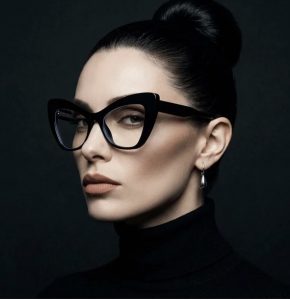
If the 1930s invented the cat eye, the 1950s perfected it. Post-war optimism and newer plastic frame materials let designers experiment with color, two-tone fronts, pearlized finishes and rhinestones set into the upswept corners. The shape became the defining women’s eyewear silhouette of the mid-century, worn by stars such as Lucille Ball, Marilyn Monroe and Audrey Hepburn and by millions of women at the office, the school gate and the cocktail party.
Hollywood helped turn the frame into a character trait. In How to Marry a Millionaire (1953), Monroe plays Pola, a near-sighted model so convinced that men dislike women in glasses that she would rather walk into walls than wear them. The film’s payoff is that she meets a man who finds her more charming with her frames on. It is a neat cinematic rebuttal to Parker’s line, and a small moment that captures the attitude Schinasi had been designing for: glasses as part of a woman’s style, not a flaw to conceal.
Through the decade, costume designers used the cat eye as visual shorthand for the modern working woman: sharp, capable, and a step ahead of everyone else in the room. That association still clings to the shape today.
Fade, Return, Repeat
No silhouette stays on top forever. By the late 1960s and 1970s, fashion’s attention had moved to oversized lenses, round wire frames and aviators, and the cat eye started to look like something from your mother’s dressing table. Through the 1980s and 1990s it lived on in vintage shops, rockabilly scenes and retro-loving subcultures that prized original mid-century frames.
That underground loyalty kept the shape ready for its comeback. As vintage dressing moved into the mainstream in the 2000s, the cat eye returned, first as sunglasses and then as everyday optical frames. Designers have since pushed it in every direction, from tiny, razor-thin cat eye sunglasses to exaggerated, sculptural wings on the runway. Each revival has reshaped the frame for its moment, which is precisely why it never feels like a costume for long.
Why the Shape Works
The cat eye’s staying power is not just nostalgia; it is good design. The frame is slightly heavier along the top and sweeps upward at the outer corners, which does three useful things:
-It lifts the face. The upward line draws the eye toward the cheekbones and temples, creating a subtle lifting effect much like a flick of winged eyeliner.
-It adds definition. Those angles bring structure to softer, rounder features without looking severe.
-It balances proportions. A stronger top line can offset a narrow chin or a long lower face.
That is why modern Cat Eye Glasses come in so many proportions, from a barely-there upturn that suits a minimalist wardrobe to a full, dramatic wing that is a statement in its own right. The basic idea Schinasi borrowed from a carnival mask still holds: a frame should flatter the face it sits on.
How to Wear Cat Eye Glasses Today
The modern cat eye is less about recreating 1955 and more about borrowing its confidence. A few guidelines help the frame feel current rather than costume.
Match the flick to your face shape
-Round faces: choose a more angular cat eye with defined points and a frame slightly wider than your face. The corners add the structure round features lack.
-Square faces: go for a softer, rounded cat eye. Gentle curves balance a strong jaw while the upturn keeps things lively.
-Oval faces: almost anything works, so this is your chance to try a bold, dramatic wing.
-Heart-shaped faces: keep the flick subtle and the top line light. A heavy brow bar can over-emphasize a wider forehead.
-Long faces: look for deeper lenses and a pronounced top line to add width and break up length.
Pick a material that sets the mood
-Tortoiseshell acetate is the classic choice: warm, polished and easy to wear to the office.
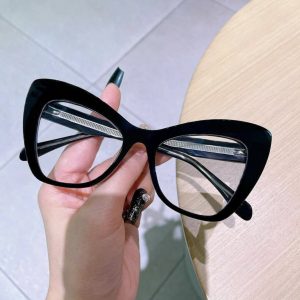
-Black is the most graphic and the most mid-century, perfect if you want the frame to be the focal point.
-Clear, crystal or blush tones soften the shape and feel fresh and modern.
-Thin metal or browline styles suggest the silhouette without shouting it, ideal for minimalists.
Style it without looking like a costume
-Let the frame do the eyeliner’s job. A cat eye already creates a lifted line, so either echo it with a slim flick of liner or keep eye makeup minimal and let the frames carry the look.
-Mind your brows. They should sit just above the top rim, not hidden behind it.
-Pair vintage with modern. A white tee, sharp tailoring or relaxed denim keeps the look grounded in the present. Save full 1950s dressing for when you actually want to make a period statement.
-Play with your hair. Sleek buns and high ponytails emphasize the frame’s upward sweep, while soft bangs that skim the top rim offer a nod to mid-century styling.
-Prioritize fit. Whether you wear them for prescription lenses or style, the frame should match the width of your face, sit comfortably on the bridge of your nose without sliding, and leave the outer corners level with or just above your eyes.
A Frame That Keeps Its Edge
Nearly a century after Altina Schinasi cut her first paper prototype, the cat eye still does what she designed it to do: it turns a practical necessity into a moment of self-expression. It has survived Hollywood typecasting, decades in the vintage bin and countless trend cycles, and each time it returns it looks a little different and a little more relevant. Whether you prefer a whisper of an upturn or a full mid-century wing, a well-chosen pair of Cat Eye Glasses remains one of the simplest ways to add character, polish and a touch of glamour to everyday style.
