

How to Spec a Custom Hoodie Manufacturer Sample

Lookbook words do not sew. Oversized, boxy, and drop-shoulder sound finished on a caption. On a table they are still empty until someone writes a chest, a shoulder point, and a body length. Before a student brief turns into a wasted sample, a custom hoodie manufacturer needs measurements, not a vibe.
Fashion education already has a dictionary for shoes and prints. Hoodies need the same habit. Jiashun Clothing says those fit names are available, and that a tech pack, a reference garment, a size chart, or clear photos can be used to review the direction. The useful move is to pick one of those objects and fill it before anyone asks for a quote.
Turn Fit Words Into Numbers First
Oversized is a chest and a length. Boxy is a side seam and a shoulder. Drop-shoulder is a distance, not a mood. Cropped is a hem that has to land on a real torso. If two people in the same class use the same word and different tapes, they are ordering two hoodies.
Write the four numbers that would let a stranger cut the block: chest, body length, shoulder position, and sleeve. Add the hood only after those four exist. A hood on an unnamed body is a hat floating over a guess.
Class critiques go wrong when everyone agrees the hoodie should look “more designer” and no one writes a millimetre. Jiashun Clothing can review oversized, boxy, drop-shoulder, cropped, and regular directions once a tech pack, a reference garment, a size chart, or clear photos exist. The factory is not a translator for adjectives. If the class cannot point to a number, the sample will invent one.
Prepare One Reference Before Anyone Quotes
Pick one object. A worn hoodie you can measure. A tech pack with those four numbers. Or photos that show front, side, and the hood up. Do not send all three with conflicting stories. Formal quotations follow after the project details are enough to review. Conflicting stories are not details. They are a delay.
Name pullover or zip-up in the same note. Those are different constructions. Hardware, pocket options, and the way the placket sits change the pattern. “Hoodie” alone is not a start.
If the class is learning a fashion dictionary, treat pullover and zip-up the way the site treats slingback and moccasin: two objects, two names. A zip-up brief that never names the hardware will come back with a zipper the sketch did not draw. A pullover brief that never names the pocket construction will come back with a bag the lookbook never showed. Write the construction next to the four numbers so the quote review has both.
Measure the reference on a flat table
Lay the garment flat. Write the units. Measure the same way you want the sample measured. If the class uses centimetres, do not mix inches in the email. A factory can review a reference. It cannot guess which of two systems you meant.
Measure the hood opening on the same table. Depth and opening are construction choices on the heavyweight notes, together with single- or double-layer. A student who writes four body numbers and then says “normal hood” has left the neck unnamed. Write the opening the way you wrote the chest. Then photograph that opening up and down so the review can see it.
Photograph the hood up and the hood down
A single face-on shot hides the neck. Take the hood up, the hood down, and a side view of the shoulder. If the drop-shoulder is the point of the brief, the side view is the brief. Without it, the word will be read as a wider chest and nothing else.
Keep the photos in one folder with the tape page. Name the files by view, not by mood. “Hero” is not a view. Front, side, hood-up, and hood-down are views. A tutor or a factory reviewer should be able to open the folder and rebuild the garment without asking which still was the joke and which still was the spec.
How to Send the Sample Brief in Order
Keep the send short. New hoodie designs normally use a paid sample, then buyer approval, then bulk. The hoodie category page lists sample development at about 10–15 working days after project details are confirmed. That clock starts when the numbers exist. It does not start when the lookbook caption exists.
1 – Write chest, length, shoulder, and sleeve on one page.
2 – Name pullover or zip-up, and the fabric face you want reviewed.
3 – Attach one reference object that matches those numbers.
4 – Ask for a sample, not a bulk date.
Ask for the sample before any colour split
Colour splits belong after the block is honest. A first sample in one colour teaches the pattern. Six colours on an unnamed block teach nothing except how to reprint a mistake. The site’s fifty-piece starting minimum is a later conversation. The first conversation is whether the shoulder you drew is the shoulder that arrived.
Common Errors That Waste the First Sample
The usual miss is a caption with no tape. The second miss is a tape with no hood photos. The third is a request to “make it more oversized” after the sample arrives, with no new number. Comments that change a specific measurement can be reviewed. Comments that change a feeling cannot.
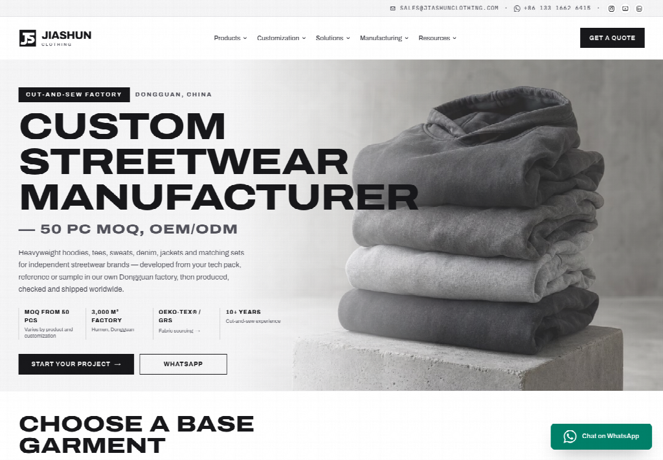
A custom hoodie manufacturer that works cut-and-sew will review fabric, fit, and artwork before quoting. That sentence is a reason to send the tape first, so the review has something to hold.
Refuse a second sample that only adds a vibe
If the first sample is wrong at the shoulder, write the new shoulder distance. If it is wrong at the hem, write the new length. Do not pay for a second sample that only says “more street.” Street is not a measurement. The second sample should be a correction of a number, or it should not be ordered.
Check the Sample the Same Way You Wrote the Brief
When the sample arrives, lay it on the same table. Use the same units. Compare the four numbers. Then put it on the intended body and look at the shoulder from the side. If the numbers match and the side view still looks like a different garment, the brief missed a measurement. Add that measurement to the note. Do not add a new adjective.
Check the cuff and hem openings the same day. The heavyweight construction notes ask you to decide whether the hem draws the body in or sits open, and how firmly the cuff holds. A student brief that never named those openings will call the sample “too tight” or “too sloppy” and still have no number for the next send. Write the finished opening you want. Then see whether the sample recovered after a normal wear.
Bulk, when you want it, is described as about 20–30 working days after sample approval. Treat it as a production window after the sample is actually approved, not as a delivery promise to a classroom door. Approving a vibe is how a class spends the next month explaining a shoulder they never wrote down.
Send Measurements Instead of a Caption
This path fits a student or a junior designer who already owns a reference and can write four numbers. Jiashun Clothing can review that package. It does not replace the dictionary work. The dictionary work is writing oversized as a chest, boxy as a seam, and drop-shoulder as a distance.
Keep a one-page spec in the same folder as the lookbook stills. The stills show the attitude. The page shows the tape. When a tutor asks why the sample looks different from the still, open the page first. If the page was empty, the still was never a brief. If the page was full and the sample missed a number, that miss can be written down and sent again.
Keep the sample when the tape and the side photo agree. Send it back, as a comment, when only the caption changed. Fashion history is full of words that moved. A hoodie pattern is not. Write the numbers. Then let the sample argue with those numbers, not with a lookbook sentence.
