

How to Digitize Vintage Fashion Archives Without Damaging Them

To digitize vintage fashion archives safely, start by sorting what you have, keep handling to a minimum, and choose a scanning method that never presses or heats fragile originals. Old family photos, dressmaking patterns, fashion sketches and magazine clippings can all be preserved as high-resolution files, provided each type of document gets the right resolution, lighting and file format.
Key takeaways
-Major institutions already treat fashion as heritage: The Met’s Costume Institute cares for 33,000 objects, and the European Fashion Heritage Association gives access to more than one million digital fashion objects.
-Fragile or bound items should be scanned without contact, with lighting that emits no UV or infrared.
-Around 300 dpi is enough for text documents; 600 dpi is the usual target for photographs and illustrations.
-Keep an uncompressed TIFF master file and make lighter JPEG copies for sharing.
-Once digitized, originals still need cool, dry and stable storage.
Why fashion archives deserve the same care as museum collections
Fashion history is not only kept in museum storerooms. It sits in shoeboxes of studio portraits, in envelopes of tissue paper patterns, in sketchbooks left by a grandmother who trained as a seamstress. These documents show how clothes were actually worn, altered and copied, which is often information that catwalk photography never recorded.
Institutions have long recognized this. The Metropolitan Museum of Art states that its Costume Institute conservation department looks after the 33,000 objects in the collection, spanning from the fifteenth century to the present. In Europe, the European Fashion Heritage Association says it gives public access to more than one million high-quality fashion digital objects, from historical dresses and accessories to catwalk photographs, drawings, sketches and catalogs. A private archive is smaller, but the logic is the same: a good digital copy reduces handling of the original and makes the material easy to share.
Choosing the right scanning method for fragile documents
The main risk when digitizing old paper is the scanner itself. A flatbed scanner presses the document against glass, which can crack brittle photographs, flatten embossed details and strain the spine of a bound album or a fashion magazine. Paper patterns, often printed on very thin tissue, tear easily when lifted on and off a glass plate.
Contactless scanning avoids these problems. The original is simply positioned and moved under the optical sensors, with no pressure applied. French studio StudioScan works this way for old archives: its large-format contactless scanner accepts documents up to 90 x 200 cm, including bound volumes, and uses LED lighting with no infrared or ultraviolet, so originals are not exposed to heat during capture. That range covers much of the oversized fashion material, such as full-size pattern sheets, posters and large sketches.
For small, flat and sturdy items, such as a recent photographic print in good condition, a careful home scan can be enough. The professional route makes sense for anything torn, bound, oversized or irreplaceable.
Resolution and file formats by type of document
Resolution determines what you can do with the file later. A text document scanned at 300 dpi is perfectly readable on screen. A photograph or illustration scanned at 600 dpi keeps enough detail to be enlarged or printed. Here is a practical starting point for the most common fashion archive items.
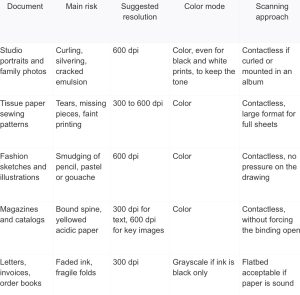
File formats matter as much as resolution. Keep one uncompressed TIFF file per document as the master copy, stored in at least two places, one of them off-site. From that master, create JPEG versions for social media, a family website or an exhibition project. Never edit or crop the master itself.
A practical example: one grandmother’s sewing box
Imagine a box containing forty family photographs from the 1950s, a dozen paper patterns with handwritten size notes, and three sketchbooks. Start with an inventory: give each item a short reference, note its date if known, its condition and anything written on the back. Photographs often carry a studio stamp or a date in pencil, which is worth capturing too, so scan both sides.
Next, decide what goes to a professional and what stays at home. Here, the sketchbooks and the patterns are the fragile part, while the sturdiest prints can be scanned at home. When the files come back, name them with the same reference used in the inventory, for example “1955-portrait-07-front.tif”. This simple discipline is what turns a folder of images into an archive you can search years later.
Storing the originals after scanning
Digitizing does not mean throwing away. Originals keep a material value, from the texture of the paper to the handwriting on a pattern, that no file fully replaces. The Library of Congress advises storing photographs in a relatively dry environment of 30 to 50% relative humidity, at 70°F or below, in a stable place away from attics, basements, radiators and exterior walls. It also recommends keeping humidity fluctuations under 5% within 24 hours.
Use acid-free boxes and folders, separate photographs from acidic paper, and handle prints by their edges, with clean hands or clean nitrile gloves. Store fragile patterns flat rather than folded tighter than they already are.
FAQ
Can I digitize vintage fashion archives with my phone?
A phone is fine for a quick record or for sharing with relatives. For preservation or printing, it introduces distortion, uneven lighting and reflections, so a scanner remains the better option for anything you want to keep long term.
What resolution should I use for old family photos?
600 dpi is a sound target for most prints. It preserves fine detail such as fabric texture and lets you enlarge the image later without visible loss.
Should I throw away the originals once they are scanned?
No. Keep them in acid-free storage under stable conditions. The digital file protects the content, but the original remains the reference and often carries information a scan can miss.
Sources: The Metropolitan Museum of Art, The Costume Institute Conservation; European Fashion Heritage Association, About us; Library of Congress, Care, Handling, and Storage of Photographs.
