

Tape Hair Extensions: The Complete Guide to Longer, Fuller Hair in 2026

Intro:
If you’ve been dreaming of thicker, longer locks without waiting years for your hair to grow, tape hair extensions may be exactly the solution you need. From Hollywood celebrities to everyday beauty enthusiasts, tape-in extensions have become one of the most popular semi-permanent hair enhancement methods on the market — and the numbers prove it.
What Are Tape Hair Extensions?
Tape hair extensions are thin wefts of real human hair (or high-quality synthetic fiber) pre-coated with a medical-grade adhesive strip. A professional stylist sandwiches a small section of your natural hair between two extension wefts, bonding them flat against your scalp. The result is a seamless, virtually undetectable finish that blends naturally with your own hair.
Clip-in extensions that you remove daily, tape-in extensions are a semi-permanent method that stays in place for several weeks. They are lightweight, lie completely flat against the scalp, and can be styled just like your natural hair — curled, straightened, colored, and even washed.
Market Behind Tape Hair Extensions
The global popularity of tape hair extensions is not just anecdotal. Within this space, the tape-in segment stands out as a particularly fast-growing category, driven by premium salon services and rising beauty consciousness among consumers worldwide.
In North America alone, hair extension services grew by 11% across salons in 2023, according to data from the Professional Beauty Association (PBA). Female consumers account for the dominant share of the market, with human Remy hair extensions continuing to set the quality benchmark in professional salon settings.
How Are Tape Hair Extensions Applied?
The application process for tape-in extensions is one of their biggest selling points. Unlike fusion or sew-in methods that can take several hours, a full tape-in installation typically takes between 45 to 90 minutes in a professional salon setting.
Here is what to expect during your appointment:
Step 1 – Hair Preparation: Your stylist will wash your hair with a clarifying shampoo to remove any oils or product buildup that could interfere with the adhesive bond.
Step 2 – Sectioning: Your hair is divided into clean, horizontal sections, starting from the nape of the neck and working upward toward the crown.
Step 3 – Sandwiching: Two extension wefts are placed above and below a thin slice of your natural hair, pressing together to create a secure, flat bond close to the scalp.
Step 4 – Sealing: The adhesive is pressed firmly using a flat tool (not heat) to ensure a strong hold. The result should be completely invisible and comfortable.
For a full head, most stylists recommend 40 to 60 pieces of tape-in extensions to achieve maximum volume and natural blending.
How Long Do Tape Hair Extensions Last?
Tape hair extensions typically last 6 to 8 weeks before needing to be repositioned. As your natural hair grows, the extension bonds gradually move away from the scalp, making readjustment necessary to maintain a seamless look and prevent matting.
The good news: tape extensions are reusable. With proper care, the same set of extension hair can be re-taped and reapplied multiple times, making them one of the most cost-effective semi-permanent options available. High-quality Remy human hair sets can last anywhere from 6 to 12 months with regular maintenance appointments.
Factors that affect longevity include:
– Hair quality — Human Remy hair lasts significantly longer than synthetic alternatives
– Hair growth rate — Faster growth means more frequent salon visits
– Product use — Oil-based products weaken the adhesive bond and should be avoided near the roots
– Lifestyle — Frequent swimming or heavy sweating can compromise the tape adhesive
Key Benefits of Tape Hair Extensions
Low Damage Risk: When applied and removed correctly by a certified professional, tape-in extensions are considered one of the least damaging semi-permanent extension methods available. The medical-grade adhesive used is the same type found in plasters and other medical-grade products.
Styling Versatility: Most tape-in extensions use 100% human Remy hair, they can be blow-dried, curled, straightened, and even color-treated just like your own hair.
Natural-Looking Results: Because the wefts lie flat against the scalp, tape-in extensions blend seamlessly into natural hair. They are virtually undetectable to both sight and touch, even in updos and ponytails.
Suitable for Fine Hair: Tape extensions are widely recommended for people with thin or fine hair because they distribute weight evenly across a larger surface area, reducing tension on individual strands compared to methods like micro-rings or sew-ins.
Quick Application: A full set can be installed in under 90 minutes — far less time than fusion bonds or hand-tied weft methods.
Potential Drawbacks to Consider
No extension method is perfect, and tape-ins do come with some considerations:
– Regular Maintenance Required: Salon visits every 6 to 8 weeks are necessary to reposition the bonds as hair grows.
– Product Restrictions: Sulfate-free shampoos are essential, and oil-based serums or conditioners must be kept away from the bonds.
– Professional Removal Needed: Attempting to remove tape extensions at home without a professional-grade adhesive remover can cause breakage or hair loss.
– Not Ideal for Active Lifestyles: Frequent swimmers or gym-goers may find the adhesive weakens more quickly due to sweat and chlorine exposure.
Tape Hair Extensions vs. Other Methods
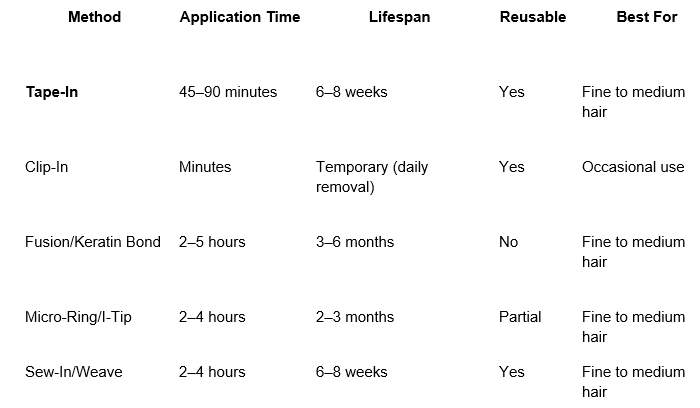
Top Tips for Caring for Your Tape Hair Extensions
1 – Avoid oil near the roots — Oils, silicones, and heavy conditioners should only be applied from the mid-lengths to the ends of the hair.
2 – Protect against heat — Always apply a heat protectant before using hot tools, and never flat-iron directly over the tape bonds.
3 – Schedule maintenance on time — Never leave tape extensions in beyond 8 weeks, as this significantly increases the risk of matting and hair damage.
4 – Use sulfate-free shampoo — Sulfates degrade the adhesive and strip moisture from the extension hair.
5 – Brush from the ends up — Always detangle from the tips toward the roots using a soft-bristle or loop brush to prevent tugging on the bonds.
6 – Sleep smart — Braid your hair loosely or use a silk pillowcase before bed to reduce friction and tangling overnight.
Who Are Tape Hair Extensions Right For?
Tape-in extensions are an excellent choice for individuals who:
– Have fine, thin, or medium-density hair and want added volume and length
– Prefer a natural-looking, discreet result
– Want a semi-permanent solution without a lengthy salon appointment
– Are new to hair extensions and looking for a lower-commitment starting point
They may not be the ideal fit for those with very oily scalps, highly active lifestyles, or those who prefer to avoid regular salon visits.
Results:
Tape hair extensions have earned their position as one of the most sought-after extension methods in the professional beauty industry — and for good reason. They offer a winning combination of natural appearance, minimal damage, quick application, and cost-effective reusability. With the global tape-in segment projected to grow at over 10% annually through 2032, it is clear that consumers and stylists alike continue to choose this method above many alternatives.
Whether you are looking to add length for a special occasion or transform your everyday look, tape hair extensions — particularly those made from ethically sourced human Remy hair — remain one of the smartest investments you can make in your hair
