

Do Collagen Supplements Actually Work? What the Research Says

Collagen supplements have become the beauty aisle’s biggest promise: smoother skin, fewer wrinkles, stronger nails, all from a daily scoop of powder. The marketing is confident. The honest question underneath it is simpler: do collagen supplements actually work, or is this another expensive placebo?
The short answer, based on the research rather than the packaging, is a qualified yes. Hydrolyzed collagen appears to produce a real but modest improvement in skin hydration and elasticity in short trials, and the reasons for the caveats are as useful to understand as the result itself.
What the Collagen Research Actually Shows
Collagen is one of the more heavily studied beauty supplements, with dozens of randomized controlled trials testing hydrolyzed collagen peptides against a placebo. Read one at a time, they scatter: some report a clear jump in skin elasticity, others a smaller change, a few almost none. That spread is normal, because each trial uses a different dose, a different age group, and a different measurement.
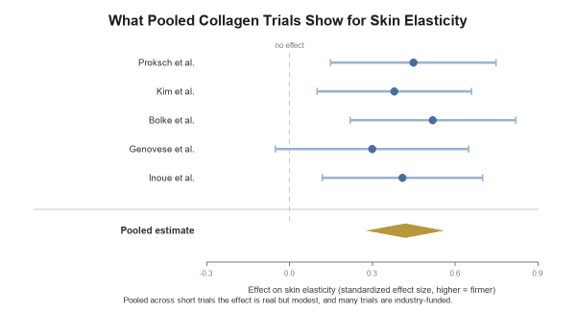
Individual collagen trials scatter; pooled together they show a real but modest effect on skin elasticity. Original illustration created for this article, royalty-free.
Pooled together, a consistent pattern appears. Across the trials, hydrolyzed collagen produces a small-to-moderate improvement in skin elasticity and hydration over eight to twelve weeks. The effect is real and repeatable, but it is modest, and it is measured over short periods, not years.
Why One Glowing Study Is Not Enough
The catch is that many collagen trials are funded by the companies that sell collagen, and industry-funded studies tend to report rosier results. Trials that find nothing are also less likely to be published, a distortion called publication bias, so the visible evidence runs more flattering than the full evidence. This is exactly why a single impressive study, or a single influencer testimonial, cannot settle the question.
The way researchers cut through this is not to trust the newest or loudest trial, but to gather every qualifying study and weigh them together. That combined view is what turns a pile of conflicting results into a number worth acting on, and it is why the standardized effect size, not a dramatic before-and-after photo, is the figure that actually answers the question.
How the Evidence Is Actually Weighed
Gathering that evidence is a formal process called a systematic review. Researchers define a precise question, search for every trial on collagen and skin, screen thousands of records down to the few dozen that qualify, appraise the quality of each, and then combine their results in a meta-analysis. Every study kept or discarded is documented in a standard chart called a PRISMA flow diagram, and free tools such as https://prismaflowdiagramgenerator.com/ build that diagram automatically, which is part of why the method has become the transparent standard for trustworthy reviews.
When a beauty claim is backed by that kind of pooled evidence, it deserves real weight. When it rests on one sponsored study or a glowing testimonial, it deserves a healthy pause.
The Practical Verdict on Collagen
So, do collagen supplements work? For skin hydration and elasticity, the pooled evidence says they can help, modestly, over a few months, with hydrolyzed collagen peptides at the doses used in trials. They are not a miracle, they will not replace sun protection, sleep or a targeted acne treatment where one is actually needed, and the strongest results tend to shrink once industry funding and short trial lengths are taken into account.
That is a more useful answer than either the hype or the backlash. The next time a supplement promises to transform your skin, the calm response is not to buy it or dismiss it on instinct, but to ask what the whole body of evidence says, and to weigh the effect that survives once every trial is counted, not just the flattering ones.
