

7 Best Custom Clothing Manufacturers in the USA | 2026 Guide

In 2026, the U.S. custom clothing manufacturing market is shaped by shorter lead times, flexible minimum order quantities, stronger quality control, and growing interest in domestic production. For fashion brands, choosing the right manufacturing partner can influence product quality, margins, production speed, and the ability to scale.
The manufacturers below serve different types of apparel businesses, from emerging designers needing development support to established brands requiring larger production capacity.
1 – Los Angeles Apparel – Los Angeles, California
Los Angeles Apparel is a major name in U.S.-based clothing production, particularly for heavyweight cotton basics and casual apparel. Its vertically integrated Los Angeles facility supports brands that need consistent production and reliable replenishment.
The company is especially well suited to brands focused on high-quality basics produced in the United States.
– Founded: 2016
– MOQ: 300+ units
– Products: T-shirts, hoodies, sweatpants, and active basics
– Best For: Brands producing high-quality Made-in-USA essentials
Its larger minimum quantities make it more suitable for businesses with established demand than designers testing a first small collection.
2 – Bomme Studio – Los Angeles, California
Bomme Studio provides cut-make-trim manufacturing for premium fashion brands. Its Los Angeles operation focuses heavily on sampling, fit correction, garment construction, and scalable domestic production.
The company can be a strong fit for brands developing more refined apparel where construction and fit require closer attention throughout the production process.
– Founded: 2018
– MOQ: 150 units per style
– Products: Dresses, tops, knit sets, fleece, and technical fashion basics
– Best For: Premium brands requiring refined fit and domestic production
Bomme Studio is particularly relevant for brands that already have developed concepts and need experienced production support to bring them into manufacturing.
3 – The Evans Group – Los Angeles, California
The Evans Group, also known as TEG, works with emerging designers and independent fashion brands that need more support throughout apparel development and production.
Rather than focusing only on high-volume manufacturing, the company guides through stages such as development, sampling, and production oversight. This can make it particularly useful for designers launching original garments or collections for the first time.
– Founded: 2005
– MOQ: 50–100 units
– Products: Dresses, fashion separates, and knitwear capsules
– Best For: Emerging designers and independent fashion startups
– Key Services: Product development, sampling, and production support
Its relatively accessible production quantities also allow smaller brands to begin with more manageable runs before moving into larger-scale manufacturing.
4 – Affix Apparel – Los Angeles, California
Affix Apparel works with startup and growth-stage clothing brands and is notable for its relatively low minimum order quantities.
Its private-label services cover several stages of bringing a product to market, including tech packs, custom trims, garment production, and branded packaging.
– Founded: 2014
– MOQ: 50 pieces
– Products: T-shirts, hoodies, leggings, denim, and uniforms
– Best For: New brands planning lower-risk product launches
For startups that do not want to commit to large initial orders, Affix Apparel provides a more accessible entry point into custom clothing manufacturing.
5 – Good Clothing Company – Fall River, Massachusetts
Good Clothing Company focuses on transparent, small-batch apparel production and works with brands that place particular importance on ethical and sustainable manufacturing.
Its production model is designed to support smaller runs while still giving brands access to development and manufacturing capabilities.
– Founded: 2015
– MOQ: 100 units
– Products: Dresses, woven tops, knitwear, and children’s apparel
– Best For: Sustainable DTC brands and ethical fashion labels
This can make the company particularly relevant for businesses looking to scale gradually without committing to very large amounts of inventory.
6 – Indie Source – Los Angeles, California
Indie Source offers full-package apparel production and supports brands across several stages of the manufacturing process.
Services include fabric sourcing, patternmaking, grading, development, and production, allowing brands to manage multiple manufacturing steps through one partner.
– Founded: 2014
– MOQ: 80+ units
– Products: Streetwear, loungewear, active basics, and kidswear
– Best For: Brands needing centralized apparel development and production
Its broad service structure can be useful for businesses that prefer to work with one production partner rather than coordinating several separate suppliers.
7 – Lefty Production Co. – Los Angeles, California
Lefty Production Co. specializes in apparel development, fabric sourcing, and higher-end garment production.
The company works with more detailed garment programs and can support brands developing collections that involve specialized fabrics, trims, or more complex construction.
– Founded: 2012
– MOQ: 100+ units
– Products: Luxury ready-to-wear, dresses, outerwear, and knit tops
– Best For: Contemporary and luxury fashion brands
Lefty Production Co. can be particularly relevant for fashion businesses where garment development and material selection are as important as the final production run.
How to Choose the Right Clothing Manufacturer
Not every clothing manufacturer will be suitable for every brand. A startup producing its first collection may have very different requirements from an established company ordering thousands of pieces.
Minimum Order Quantity
MOQ is one of the first factors to compare. U.S. manufacturers commonly require anywhere from around 50 units to several hundred units per style.
Smaller brands may prefer lower MOQs because they reduce the amount of inventory and capital required for an initial production run.
Product Development Support
If your design is still at the concept stage, look for manufacturers that can help with:
– Tech packs
– Patternmaking
– Fabric sourcing
– Sampling
– Fit adjustments
– Grading
– Production preparation
Brands with fully developed designs may need less support and can focus more heavily on manufacturing capacity and pricing.
Product Specialization
Manufacturers often have stronger capabilities in certain product categories.
A factory specializing in basic T-shirts may not be the best partner for structured dresses, luxury outerwear, knitwear, or technically complex garments.
Review previous work and confirm that the manufacturer has experience with products similar to yours.
Lead Times
Production timelines depend on garment complexity, order size, fabric availability, sampling requirements, and factory capacity.
Domestic production can reduce shipping time, but brands should still ask each manufacturer for realistic sampling and production schedules before placing an order.
Quality Control
Brands should request samples and review details such as:
– Fabric weight and composition
– Stitching
– Seam construction
– Measurements
– Shrinkage
– Color consistency
– Finishing
– Packaging
Clear technical specifications help reduce misunderstandings once production begins.
What Is a Realistic MOQ for U.S. Clothing Manufacturing?
For many U.S. custom clothing manufacturers, minimum quantities start somewhere between approximately 50 and 300 units per style.
Simpler products may support lower minimums, while more complicated garments or production processes can require larger orders.
Small brands should confirm whether the stated MOQ applies per style, color, size, or total order because these requirements can vary considerably between manufacturers.
Is U.S. Clothing Manufacturing Faster Than Overseas Production?
Domestic manufacturing can reduce transit times and make communication easier, but it is not automatically faster in every situation.
Factory capacity, sampling revisions, fabric availability, and how well the technical package is prepared can all influence production speed.
A detailed tech pack and clear approval process can help prevent delays regardless of where the manufacturer is located.
What Should Be Included in a Clothing Tech Pack?
A professional tech pack should give the manufacturer enough information to reproduce a garment accurately.
Important details may include:
– Measurement specifications
– Size grading
– Measurement tolerances
– Fabric references
– Stitch types
– Trim information
– Labels
– Color specifications
– Construction notes
– Packaging instructions
The more precise the technical information is before sampling begins, the easier it becomes to identify and correct production issues early.
Should Brands Use Different Manufacturers for Different Products?
In many cases, yes.
A manufacturer that performs well with T-shirts and hoodies may not have the same expertise in denim, structured outerwear, sweaters, or luxury dresses.
Brands with several product categories may benefit from using specialist manufacturers for different parts of their collection instead of expecting one factory to handle everything equally well.
Conclusion
The best custom clothing manufacturer in the USA depends on your product, production volume, budget, development needs, and plans for growth.
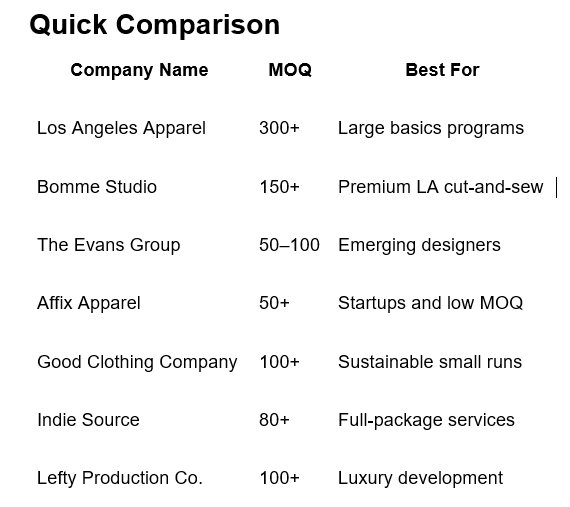
Los Angeles Apparel can support larger programs focused on quality basics, while Bomme Studio works with premium cut-and-sew production. The Evans Group provides development and smaller production options for emerging designers, while Affix Apparel offers lower entry quantities for startups.
Good Clothing Company provides an option for sustainability-focused small runs, Indie Source offers full-package development and manufacturing, and Lefty Production Co. serves brands developing more complex and premium garments.
Before selecting a partner, compare minimum quantities, production capabilities, lead times, communication, technical expertise, and experience with your specific type of apparel.
