

Virtual Try-On Goes Mainstream: How AI Image Tools Are Changing Fashion Photography Without a Studio

Virtual try-on technology has moved well past its early novelty phase, where it existed mostly as a gimmicky app feature, into something major retailers are now building directly into their shopping experiences. Higgsfield’s top notch feature is AI Image Editor that reflects the same underlying shift on the production side of fashion, letting designers and brands generate on-model, styled fashion imagery from a single garment photo, without booking a studio, a model, or a photographer.
That shift matters for an industry where photography has always been one of the largest recurring costs in bringing a collection to market, and where the gap between an established fashion house and an independent designer has often come down to who could afford a proper photoshoot. That gap is exactly what this new generation of AI image tools is starting to close, one collection at a time.
Why Has Virtual Try-On Moved From Novelty to Necessity?
Major retailers have begun introducing virtual try-on features directly into their shopping experiences, letting customers preview how a garment will look before purchasing. That shift reflects a broader industry recognition that the gap between a product photo and how a garment actually looks on a body has always been one of the biggest sources of friction in online fashion shopping.
On the production side, that same underlying technology, generating realistic, on-model imagery from a flat garment or product photo, has become just as relevant to how fashion brands and designers create their marketing and catalog content in the first place, not just how customers preview it before buying. The two use cases, customer-facing preview and brand-side production, are converging around the same underlying AI capability, even though they solve very different problems for very different audiences.
What Has Traditional Fashion Photography Cost Brands and Designers?
A traditional fashion photoshoot involves booking a studio, a model, a photographer, and a full post-production process, a combination of costs that has always put professional-quality campaign imagery out of reach for smaller and independent designers. Even established brands face a real constraint: producing fresh, styled imagery for every SKU in a growing collection multiplies that cost significantly across an entire seasonal launch and every subsequent restock.
That cost structure has historically forced a tradeoff, reserving full photoshoots for a handful of hero pieces while relying on flat, unstyled product shots for the rest of a collection. As online shopping has made styled, on-model imagery an expectation rather than a luxury, that tradeoff has become harder to sustain for brands without a large production budget, particularly as customer expectations around visual quality continue to climb across every price point, from fast fashion to luxury alike.
How Are AI Image Tools Actually Replacing the Photoshoot?
AI image editing addresses this gap directly by generating realistic on-model imagery from a single garment or product photo, without a studio session or a model booking. A designer can upload a flat-lay or mannequin shot of a single piece and generate a styled, on-model version, complete with a chosen setting, pose, and mood, in a fraction of the time a traditional shoot would require.
This matters most for the kind of everyday content need that has traditionally been the first thing cut when a photography budget runs tight, catalog imagery for a full size and color range, seasonal refreshes, and campaign variations for different platforms and markets. What used to require choosing which pieces of a collection got the full photoshoot treatment, and which were left with flat, uninspiring product shots, increasingly no longer requires that same tradeoff.
How Does Higgsfield Fit Into This Shift?
Rather than functioning as a single-purpose fashion tool, Higgsfield operates as a broader AI creative suite, bringing image editing together with generation, video, and upscaling in one platform. For a designer or brand, that breadth matters because fashion content rarely stops at a single still image, a collection launch might need lookbook photography, social graphics, and video content, all of which can come from the same Higgsfield workspace rather than several disconnected tools, each requiring its own account and learning curve.
Higgsfield’s AI Image Editor gives users access to 15 or more leading image models, including Nano Banana Pro, Seedream, and FLUX, in one workspace, letting a designer compare which model renders fabric texture, drape, and fit most convincingly for a specific garment or fabric type before committing to a final direction. As covered in Catwalk Yourself’s earlier piece on sustainable fashion in the digital age, AI tools like virtual try-on are already reshaping how the industry thinks about production and waste, and platforms like Higgsfield extend that same shift directly into how fashion imagery gets made in practice.
What Capabilities Matter Most for Fashion Photography?
A handful of specific features determine whether an AI image tool actually holds up for the demands of fashion-specific imagery.
Preserving Garment Detail Through the Editing Process
Fashion photography lives or dies on detail, fabric texture, stitching, print alignment, and drape all need to survive the editing process intact. Higgsfield’s editing tools are designed to preserve these details while changing the surrounding scene, pose, or model, rather than flattening a garment into something generic in the process, a failure point that has historically undermined AI-generated fashion imagery and made brands hesitant to trust it for anything customer-facing.
Producing Consistent Imagery Across an Entire Collection
A collection needs to look like a collection, with consistent lighting, styling, tone, and mood across every single piece included. Higgsfield supports consistent styling across generations, letting a designer apply the same visual language across an entire size run or product line without each image looking like it came from a different shoot, even when the individual images were generated separately over the course of several days or weeks rather than in a single continuous session.
Moving From Product Shot to Styled Campaign Image
Higgsfield allows an image to move from a simple product photo into a fully styled scene, complete with background, lighting, and mood, and then push that same asset into video generation if a campaign calls for motion. That continuity between still and moving image matters for a brand trying to produce a cohesive campaign across multiple formats from a single source photo, without handing the asset off to a separate video production process partway through the campaign timeline.
How Does This Compare to a Traditional Photoshoot?
The practical gap between a traditional fashion photoshoot and AI-generated fashion imagery becomes clear once cost and turnaround enter the picture, a gap platforms like Higgsfield are specifically built to close.
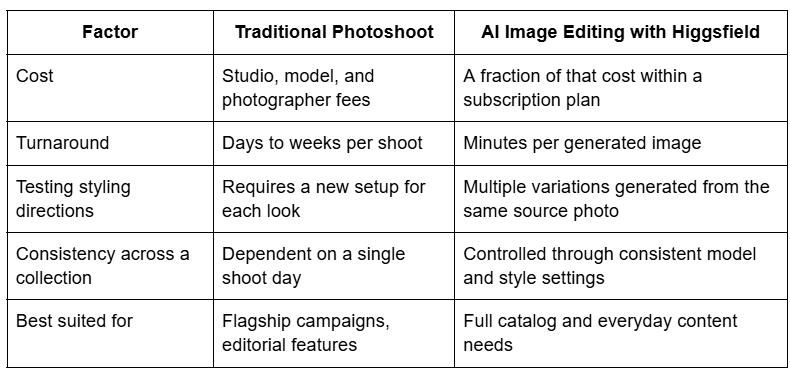
That comparison doesn’t diminish the value of a real photoshoot for a brand’s most important campaign moments, where a genuine creative vision and human styling still matter enormously. What it changes is how much of a brand’s everyday catalog and marketing imagery realistically needs to depend on that heavier process at all, freeing up whatever photography budget remains for the campaigns where it genuinely earns its cost and creative payoff.
Who Is Adopting Virtual Try-On Fastest?
Independent and emerging designers without the budget for a full photoshoot are among the most natural adopters, since AI image editing removes the single biggest financial barrier between a finished garment and professional-looking campaign imagery. E-commerce brands managing large, frequently changing catalogs benefit similarly, generating on-model imagery across a full size and color range without a proportional increase in photography costs or scheduling logistics.
Fashion students and design programs represent a further adopter group, using Higgsfield to visualize how a garment reads on a body before committing to a full production run or portfolio shoot, a use case that lets students test far more design directions than a traditional student budget would ever allow, and that mirrors the same iterative testing professional design studios have started to adopt. Sustainable and small-batch fashion labels, the kind of brands Catwalk Yourself has already covered in the context of AI and sustainability, are finding particular value in reducing the resource footprint tied to traditional photo production alongside garment production itself, since fewer physical samples need to be produced purely for photography purposes, and less travel and equipment is required for a shoot that no longer needs to happen at all.
What Should Designers and Brands Keep in Mind?
AI-generated fashion imagery works best as an extension of a brand’s actual creative direction, not a replacement for it. A designer still needs to bring the styling sense, the color story, and the mood that makes a collection distinctive, the technology handles the production mechanics of turning that vision into finished imagery rather than generating the creative vision itself, a distinction that matters for maintaining a brand’s genuine identity as the technology becomes more widely used across the industry.
Brands should also be thoughtful about how AI-generated imagery represents fit and sizing, since virtual try-on technology simulates a garment’s appearance rather than guaranteeing an exact physical fit, a distinction that matters for maintaining customer trust around sizing and returns. Being transparent with customers about which imagery is AI-generated versus a traditional photograph is also becoming a more common practice as the technology sees wider adoption across the industry.
How Can a Brand Get Started?
Higgsfield is free to start with, offering daily generation credits that let a designer or brand test the platform against a single garment before committing further. A practical starting point is uploading a photo of one existing piece and generating a few styled variations to compare against what a traditional shoot for the same piece would have cost and taken to produce, giving a designer a direct, concrete sense of the tradeoff rather than an abstract one.
Brands managing a full catalog benefit from testing across a handful of different garment types, structured pieces, flowing fabrics, prints, before deciding how broadly to build AI image editing into a regular production workflow across an entire team, since different fabric and garment types can behave differently through the generation process. A structured blazer and a flowing silk dress may not translate through the same model with equal fidelity and accuracy, which is exactly why testing across a representative sample of a collection matters before committing to the approach at scale across an entire seasonal line.
What Does This Mean for the Future of Fashion Photography?
As virtual try-on continues moving from a shopping-experience feature into a core part of how fashion imagery gets produced, the gap between what an established fashion house and an independent designer can produce visually is likely to keep narrowing. That shift doesn’t eliminate the value of traditional photography for a brand’s most important creative moments, but it does mean the everyday work of producing catalog and campaign imagery no longer needs to be gated by studio budgets the way it always has been.
For an industry historically defined by who could afford to produce the imagery that sold a collection, that shift is likely to matter as much to how fashion actually gets made and marketed as any single trend on the runway itself. Platforms structured around this shift, Higgsfield among them, suggest that the next meaningful divide in fashion won’t be between brands with access to AI tools and those without, but between brands that learn to use them thoughtfully and those that treat them as a shortcut around genuine creative direction. That distinction is likely to matter more, over time, than which specific platform a brand happens to choose.
