

The New Neoclassicism: How Contemporary Drape Reclaims Ancient Couturiers’ Techniques

In the lexicon of fashion history, drape is the ultimate test of a designer’s relationship with fabric. Unlike tailoring—which forces a textile to conform to the body’s parameters through strict cutting and seaming—draping allows the weight and weave of the material to dictate the silhouette. It is a dialogue between gravity and cloth.
While the structured, hyper-tailored shoulders of the late 20th century often dominate our conversations about modern silhouettes, a quiet, neoclassical counter-revolution is happening. Designers and independent ateliers are looking past the rigid, synthetic armor of fast fashion. Instead, they are returning to the ancient, fluid geometry of classical antiquities. This shift represents a deeper appreciation for textile mechanics, tracing its lineage back to classical antiquity.
The Legacy of Classical Fluidity
The origin of the draped silhouette lies in ancient Greece, where garments like the chiton and peplos were entirely unstructured. They were simply rectangular pieces of woven textile, pinned at the shoulders and bound at the waist. The aesthetic value lay entirely in how the fabric folded, shifted, and moved when the wearer walked.
In the 20th century, this classical methodology was famously resurrected by Alix Grès, known to the couture world as Madame Grès. She spent hours draping jersey and silk directly onto her fit models, rejecting paper patterns in favor of intuitive, sculptural pleating. Later, designers like Sophia Kokosalaki brought a darker, more contemporary edge to this neoclassicism, proving that ancient draping techniques could look incredibly modern, even rebellious.
Today, this preoccupation with the organic, unforced silhouette has found a new medium: premium linen.
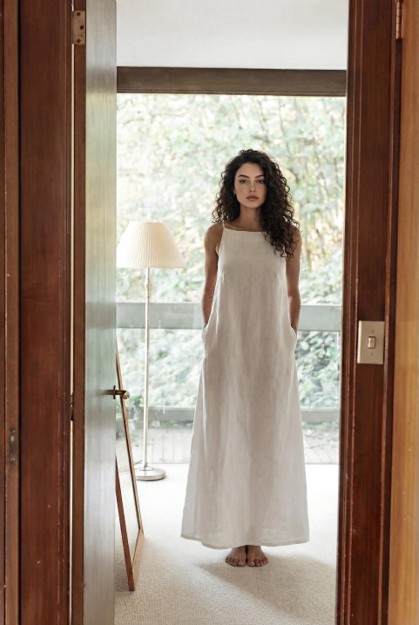
The Materiality of Modern Drape
Draping requires a textile with genuine character. Synthetic blends often fall flat, lacking the weight or natural friction needed to hold a shape beautifully. This is why contemporary, conscious brands like Sonfre are focusing their design philosophies entirely on raw, heavy-weight European Flax™.
Linen has a unique physical structure. Its fibers are longer and stronger than cotton, giving it a crisp hand-feel that gradually softens over time. When draped, it doesn’t cling; instead, it hangs with a certain architectural presence. The natural irregularities and slubs in the weave catch the light in a way that smooth, industrial synthetics never can, giving even the simplest garment a tactile, sculptural quality.
From the Runway to the Everyday Wardrobe
On the runway, we frequently see neoclassicism expressed in delicate, sweeping gowns that are impractical for daily life. However, the modern translation of this aesthetic is much more grounded, translating ancient draping principles into functional, everyday uniforms.
We see this play out in the resurgence of the structured yet relaxed linen dress with sleeves. From a pattern-making perspective, draping a sleeve using a stiff or synthetic fabric often results in restricted movement or harsh, unnatural folds around the armscye. By contrast, a relaxed linen sleeve utilizes the fabric’s natural weight to drop softly over the shoulders, creating a clean, unforced line that moves with the wearer. These designs discard the restrictive, zipped bodices of mid-century fashion in favor of fluid shift cuts, soft scoop necklines, and elegant proportions that do not rely on synthetic stretch to fit the body.
Ultimately, this return to neoclassical draping isn’t just a nod to historical aesthetics. It is a rejection of the hyper-industrialized, fast-paced fashion cycle. By returning to raw, certified textiles and intuitive, flowing shapes, modern designers are reminding us of a fundamental truth of fashion history: the most enduring garments are those that allow the fabric, and the wearer, to move freely.
